

Early Learning Environment for Young Children
Preschool is an early childhood learning stage designed for children between 2 to 5 years old. It provides a safe, structured and engaging environment where children begin their learning journey before formal schooling.
At this stage, children are introduced to basic routines, communication habits and group activities. The main goal is to help them develop confidence, independence and curiosity in a playful learning environment.
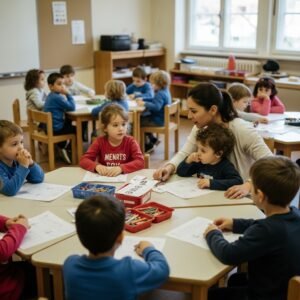
Preschool is not only about academic learning it also focuses on emotional, physical and social development that shapes a child’s personality.
Key Benefits of Preschool Education
Preschool helps children build strong foundations that support long-term growth and learning.
Social Interaction Skills
Children learn how to interact with others, share toys, take turns and communicate in groups. This helps them build healthy relationships from an early age.
Early Cognitive Development
Basic concepts such as numbers, letters, shapes and patterns are introduced through fun and activity based learning.
Emotional Confidence
Children become more independent and learn how to manage emotions when they spend time in a guided learning environment.
Language Development
Storytelling, songs and classroom conversations improve vocabulary and communication skills.
School Readiness
Preschool prepares children for formal education by teaching discipline, classroom behavior and daily routines.
Understanding STEAM Learning in Preschool
Modern preschools use advanced learning approaches like STEAM education to enhance creativity and thinking skills.
STEAM stands for:
- Science
- Technology
- Engineering
- Arts
- Mathematics
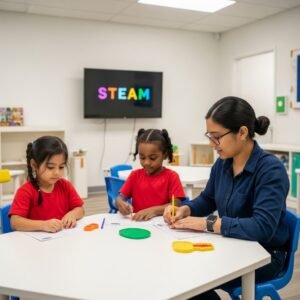
Instead of traditional memorization, STEAM focuses on learning through activities, exploration and hands-on experiences. Children experiment, build, draw and solve simple problems in a creative way.
How STEAM Helps Child Development
STEAM learning is designed to develop important future skills in children.
Encourages Curiosity
Children naturally begin asking questions and exploring how things work.
Builds Problem-Solving Ability
Simple challenges help children think and find solutions independently.
Improves Creativity
Art and hands-on projects allow children to express ideas freely.
Enhances Critical Thinking
Activities help children observe, compare and understand patterns in daily life.
Importance of Preschool with STEAM Approach
When preschool learning is combined with STEAM methods, it creates a balanced educational foundation. Children not only learn basic academic concepts but also develop creativity, curiosity and logical thinking skills.
This combination prepares children for future academic success and builds confidence in learning new concepts.
Conclusion
Preschool education plays a vital role in shaping a child’s early development. It builds social skills, emotional strength and basic academic understanding. When combined with STEAM learning, it becomes more effective by encouraging creativity, curiosity and problem solving abilities. A strong preschool foundation helps children transition smoothly into formal schooling and supports lifelong learning.
FAQs
At what age should a child start preschool?
Most children start preschool between 2 and 5 years of age, depending on readiness.
Why is preschool important for early development?
It builds social, emotional and basic academic skills in a structured environment.
What is STEAM learning in simple words?
STEAM is a learning method that includes Science, Technology, Engineering, Arts and Mathematics through activities and exploration.
Does preschool improve communication skills?
Yes, activities like storytelling and group interaction improve language development.
Is STEAM necessary in preschool education?
It is highly beneficial because it develops creativity, curiosity and problem solving skills.
